Archives
-
Vol. 13 No. 2Si (2025)
This special issue of the Recoletos Multidisciplinary Research Journal (RMRJ) features selected peer-reviewed papers from the International Conference on Sustainable Environmental Technologies (ICSET 2025), jointly organized by Mapúa University (Philippines) and National Chung Hsing University (Taiwan). The 2025 conference marks a milestone, coinciding with Mapúa University’s 100th anniversary, underscoring a century-long commitment to engineering excellence, sustainability, and international academic collaboration.
ICSET traces its origins to the Asian Pacific Regional Conference (APRC), first convened in 2003 at Chia Nan University of Pharmacy and Science in Taiwan, bringing together scholars from Thailand, the Philippines, Japan, and Korea. Over the following years, the conference rotated among leading institutions across Asia, including the University of the Philippines Diliman, Khon Kaen University, Hanoi University of Science and Technology, and Ubon Ratchathani University. In 2011, the conference formally evolved into ICSET, with subsequent editions hosted by Seoul National University in Korea and King Mongkut’s University of Technology Thonburi in Thailand. After a temporary suspension during the COVID-19 pandemic, ICSET 2025 renews this long-standing tradition by once again convening the international scientific community to advance environmental technologies for sustainability, green living, and socio-economic development.
The papers published in this special issue reflect ICSET’s multidisciplinary scope, encompassing digital innovation, renewable energy systems, urban water management, sustainable food technologies, intelligent robotics, and emerging virological research. Educational transformation in the post-pandemic era is examined in “Tri-X Modality Continuance: A Digital Learning Innovation in the Context of the New Normal,” while decentralized clean energy solutions are advanced in “A Sustainable and Eco-Efficient Pico Hydroelectric Technology for Decentralized Power Generation in Remote Hydrological Environments.” Urban resilience and water security are addressed through “Photogrammetric Assessment of Urban Rainwater Catchment Systems in Cebu City, Philippines: Implications for Water Resource Optimization and Flood Mitigation.”
Food sustainability and agri-biotechnology are explored in “Herd Forecasting and Acceptance Analysis of Sustainable Meat Production through 3D-Bioprinted Meat from Fish Stem Cell,” alongside biodiversity-oriented automation in “Avian Pro: Intelligent Robot for Philippine Sparrow Detection and Deterrence using Laser Pointer.” Molecular and ecological dimensions of emerging pathogens are investigated in “Conserved Internal PB2–PB1–PA–NP–M Genes and Divergent HA/NA in Bat Influenza A Viruses H9N2, H17N10, and H18N11,” highlighting the intersection of environmental systems, wildlife, and public health.
Together, these contributions demonstrate that ICSET 2025 serves as a platform for cross-sectoral research, technological innovation, and international collaboration to address sustainability challenges in energy, water, ecosystems, food security, and education. Through this special issue, RMRJ reinforces its mission to disseminate high-impact multidisciplinary scholarship that supports sustainable development goals, strengthens regional research networks, and contributes to global conversations on environmental technologies and green growth.
Prof. NILO T. BUGTAI, Ph.D.
Guest Editor
Full Professor of Manufacturing Engineering and Management (MEM)
Director, Institute of Biomedical Engineering and Health Technologies (IBEHT)
De La Salle University, Manila, Philippines -
Vol. 13 No. 2 (2025)
The December 2025 issue of the Recoletos Multidisciplinary Research Journal presents a rich collection of interdisciplinary scholarship addressing pressing global and regional concerns, ranging from biodiversity conservation and water resource management to health systems innovation, educational development, food safety technologies, and societal resilience. Collectively, the studies in this issue contribute to advancing the United Nations Sustainable Development Goals (SDGs) 1 (No Poverty), 2 (Zero Hunger), 3 (Good Health and Well-Being), and 4 (Quality Education).
This regular issue features nine articles and one perspective paper authored by 42 researchers affiliated with 12 institutions across five countries. Participating institutions include, from the Philippines: the University of San Jose-Recoletos, Biliran Province State University, the University of San Carlos, and Bicol State College of Applied Science and Technology; from Indonesia: Universitas Kristen Indonesia, Universitas Negeri Malang, Universitas Gadjah Mada, and Konimex Diagnostic Center; from China: Renmin University of China; from Pakistan: the National University of Modern Languages; from Thailand: King Mongkut’s University of Technology; and from Nigeria: Federal University Dutse.
The articles in this issue explore diverse disciplinary perspectives and methodologies, including:
- An Ethnobiological Study of Indigenous Knowledge on the Traditional Production of Coconut Sugar in the Somongari Javanese Community
- Mycological Profiling and Taxonomic Inventory of Macrofungi in Biliran Province, Philippines: Insights into Island Biodiversity Records and Conservation
- Determinants of Switching Intentions to E-Health Services among Healthcare Service Users: A Push–Pull–Mooring Perspective from Islamabad, Pakistan
- Advancing Early Childhood Learning through Structured Multimodal Engagement: Evidence from Kindergarten Classrooms
- Biochemical Characterization and Antimicrobial Potential of Soil-Derived Bacillus Isolates
- Leveraging a Tiered Instruction Strategy to Enhance Reading Comprehension and Quality Education: An Action Research Study among Early Elementary Learners in the Philippines
- FreshTrack: Enhancing Household Food Safety through an RFID-Enabled Food Expiry Monitoring System
- Linking Barrett’s Taxonomy to Reading Comprehension and Problem-Solving: Implications for Mathematics Performance in Primary Education
- Optimizing Magnetite Synthesis for DNA Extraction: A Factorial Design Analysis of Temperature, pH, and TEOS Ratio Effects on Yield and Purity
- Phase Change and the Limits of Resilience: A Physics-Inspired Lens on Societal Fragility and Collapse
Through these contributions, the journal continues its commitment to fostering multidisciplinary inquiry, promoting international research collaboration, and disseminating knowledge that informs policy, practice, and sustainable development in local and global contexts.
-
Special Issue (2025)
Vol. 1TeknoLunas—Transforming Lives through Healthcare Innovation and Biomedical Engineering
This special issue of the Recoletos Multidisciplinary Research Journal presents selected peer-reviewed papers from TeknoLunas 2024, the national conference organized by the De La Salle University Institute of Biomedical Engineering and Health Technologies (DLSU-IBEHT) in partnership with the Department of Science and Technology–Philippine Council for Health Research and Development (DOST-PCHRD) and hosted by the University of San Jose-Recoletos. Convened at the USJ-R Main Campus in Cebu City, Philippines, from September 04 to 06, 2024, with the theme Advancing Philippine Healthcare through Innovations and Collaborations, Transforming Health Research into Biomedical Devices, Bridging the Gap for Equitable and Accessible Healthcare Delivery in the Philippines.
Reflecting the conference’s core thrusts on innovation, collaboration, and commercialization, the articles in this issue span device engineering, rehabilitation technologies, digital health, nursing science, behavioral health, and biomedical materials research. Engineering-focused contributions include “Design and Development of an Ankle Rehabilitation Device,” “Comparative Finite Element Analysis of Exoskeleton Materials for Durability in Rehabilitation,” and “The Radiation Attenuation Property of High-Density Polyethylene Doped with Zinc Oxide as an Alternative Gonadal Shield,” which demonstrate locally grounded solutions for assistive technologies and clinical protection. Complementing these are broader assessments of national and regional innovation landscapes in “Robotic Rehabilitation Devices in the Philippines: A Review of Recent Advancements” and “Challenges and Opportunities in Developing Stroke Rehabilitation Technologies in the Visayas Region: A Local Regional Perspective.”
Community- and patient-centered innovations are featured in “Evaluating a Community-Based Rehabilitation Program Using Provus Discrepancy Evaluation Model” and “Pitik: A Cebuano-Binisaya Intent-Based Chatbot for Cardiovascular Disease Patient Profiling and Risk Factor Recommendations,” underscoring TeknoLunas’ emphasis on accessible technologies and culturally responsive digital health tools. Nursing and behavioral health research further enrich the issue through qualitative and mixed-methods inquiries such as “The Sense Theory of Situatedness of Male Nurses in Nursing: A Constructivist Grounded Theory Study” and “From Smoke to Mist: The Lived Experiences of Nursing Students Who Transitioned the Use of Traditional Cigarettes to E-Cigarettes.” Finally, laboratory-based biomedical investigations are represented by “The Antiangiogenic Activity of the Pereskia grandifolia (Seven Star Needle) Crude Leaf Extract Using the Chick Embryo Chorioallantoic Membrane (CAM) Assay,” highlighting the translational potential of plant-based therapeutic research.
Collectively, these contributions illustrate how TeknoLunas functions as a catalyst for interdisciplinary scholarship that bridges engineering design, clinical practice, public health, and social inquiry. They reinforce national priorities for sustainable healthcare development, regional innovation capacity, and technology transfer, while aligning with the mission of DOST-PCHRD and DLSU-IBEHT to ensure that biomedical innovations reach Filipino communities most in need.
Through this special issue, the Recoletos Multidisciplinary Research Journal reaffirms its commitment to disseminating impactful multidisciplinary research that advances healthcare innovation, supports health-related Sustainable Development Goals, and strengthens the Philippines’ role in the global biomedical research landscape.
-
Vol. 12 No. 1 (2024)
The Recoletos Multidisciplinary Research Journal (RMRJ) June 2024 issue features a diverse range of articles covering Math, Engineering and Technology, Education, Language, Culture and Society, and Environment and Health. This issue promises to be an insightful read, with contributions from researchers across various disciplines.
In the Math, Engineering, and Technology section, readers will be acquainted with studies on topics such as almost difference sets from Unions of Cyclotomic Classes, robotic surgical systems, solar-powered light traps, and pectin-based cell immobilization. These articles showcase the innovative work being done in these fields and their potential real-world applications.
The Education section looks into critical areas like sustainable development in secondary schools, the impact of game-based activities on student learning, and the integration of multimodality in science education. These studies provide valuable insights for educators and policymakers.
The Language, Culture, and Society section explores indigenous cosmology, the use of L1 in ESL classrooms, the development of a flourishing scale for Filipino older adults, and the alignment of higher education with the job market. These interdisciplinary works contribute to our understanding of cultural, social, and educational dynamics.
Finally, the Environment and Health section examines the impact of small-scale gold mining on water resources and the use of IoT and geospatial analytics for sustainable fisheries management. These timely and relevant studies address pressing environmental and resource management challenges.
Overall, the June 2024 issue of the Recoletos Multidisciplinary Research Journal promises to be a diverse and engaging read, showcasing the breadth and depth of research being conducted across various disciplines. The journal's commitment to promoting knowledge and addressing real-world issues is evident in the carefully curated selection of articles.
Prof. NILO T. BUGTAI, Ph.D.
Editor-In-Chief
Full Professor of Manufacturing Engineering and Management (MEM)
Director, Institute of Biomedical Engineering and Health Technologies (IBEHT)
De La Salle University, Manila Philippines -
Vol. 10 No. 2 (2022)
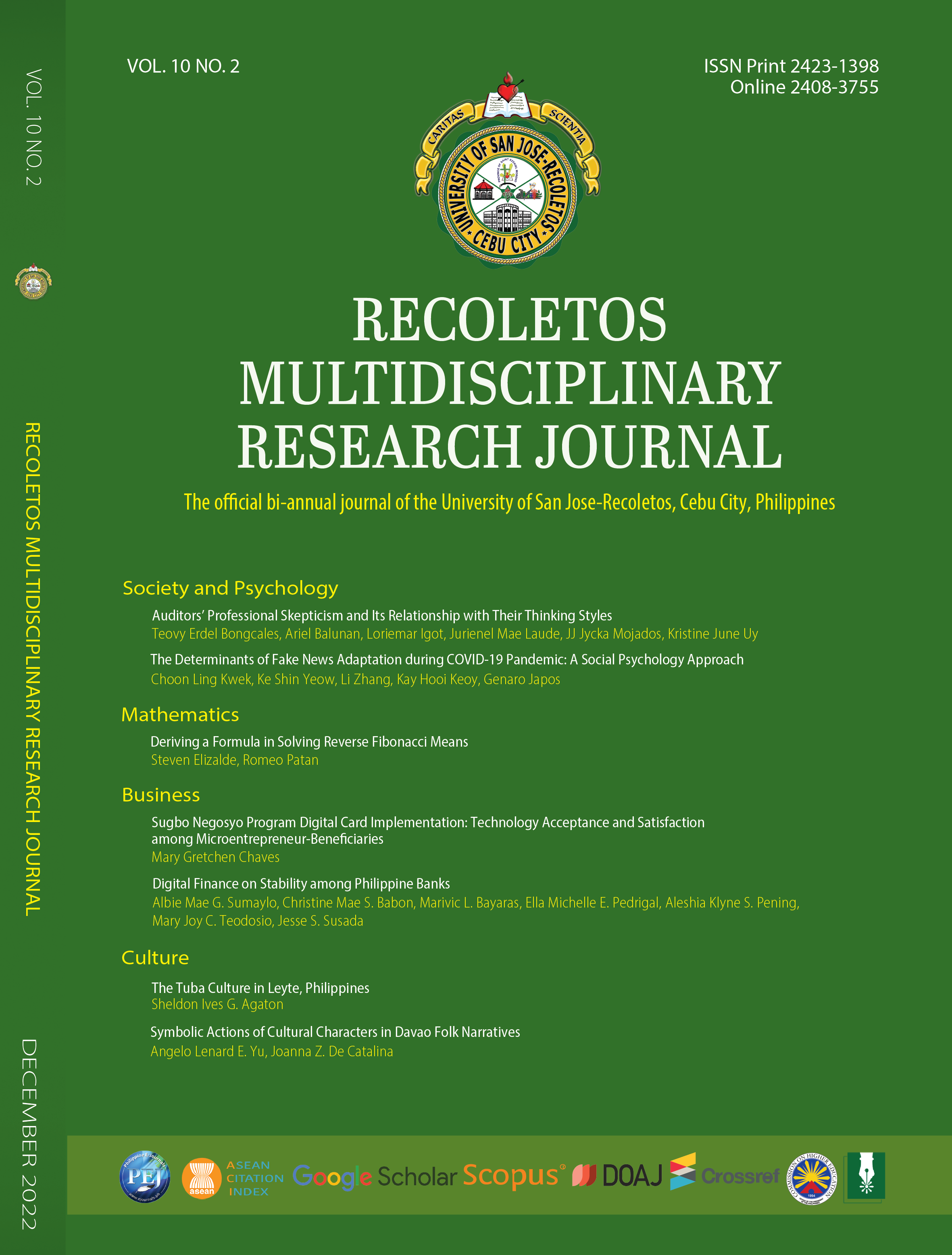
Welcome 2023!
The water rabbit in the Chinese culture is associated with intuity and thoughtfulness (shorturl.at/KLOPR). At first glance, these characteristics may seem far from what a researcher needs, but in hindsight, to work using one’s instinct and to be in “the state of being absorbed in thought” are often necessary for research work.
In RMRJ’s December issue, the authors’ intuition and thoughtfulness, vis a vis the methodological rigor they employed, are showcased.
Under Society and Psychology, the Auditors’ Professional Skepticism and Its Relationship with Their Thinking Styles and The Determinants of Fake News Adaptation during COVID-19 Pandemic: A Social Psychology Approach were explored.
In Math, the readers will be brought to an investigation of Deriving a Formula in Solving Reverse Fibonacci Means.
The Business community will be presented with updating and how these efforts fared in Sugbo Negosyo Program Digital Card Implementation: Technology Acceptance and Satisfaction among Microentrepreneur-Beneficiaries and Digital Finance on Stability among Philippine Banks.
Culture will be unveiled in The Tuba Culture in Leyte, Philippines, and the Symbolic Actions of Cultural Characters in Davao Folk Narratives.
Thank you for being part of the academic discussion in RMRJ. We look forward to your active contribution in the ongoing conversation.
Professor NILO T. BUGTAI, Ph.D.
Editor-In-Chief
Full Professor of Manufacturing Engineering and Management (MEM)
Director, Institute of Biomedical Engineering and Health Technologies (IBEHT)
De La Salle University, Manila Philippines -
Vol. 10 No. 1 (2022)
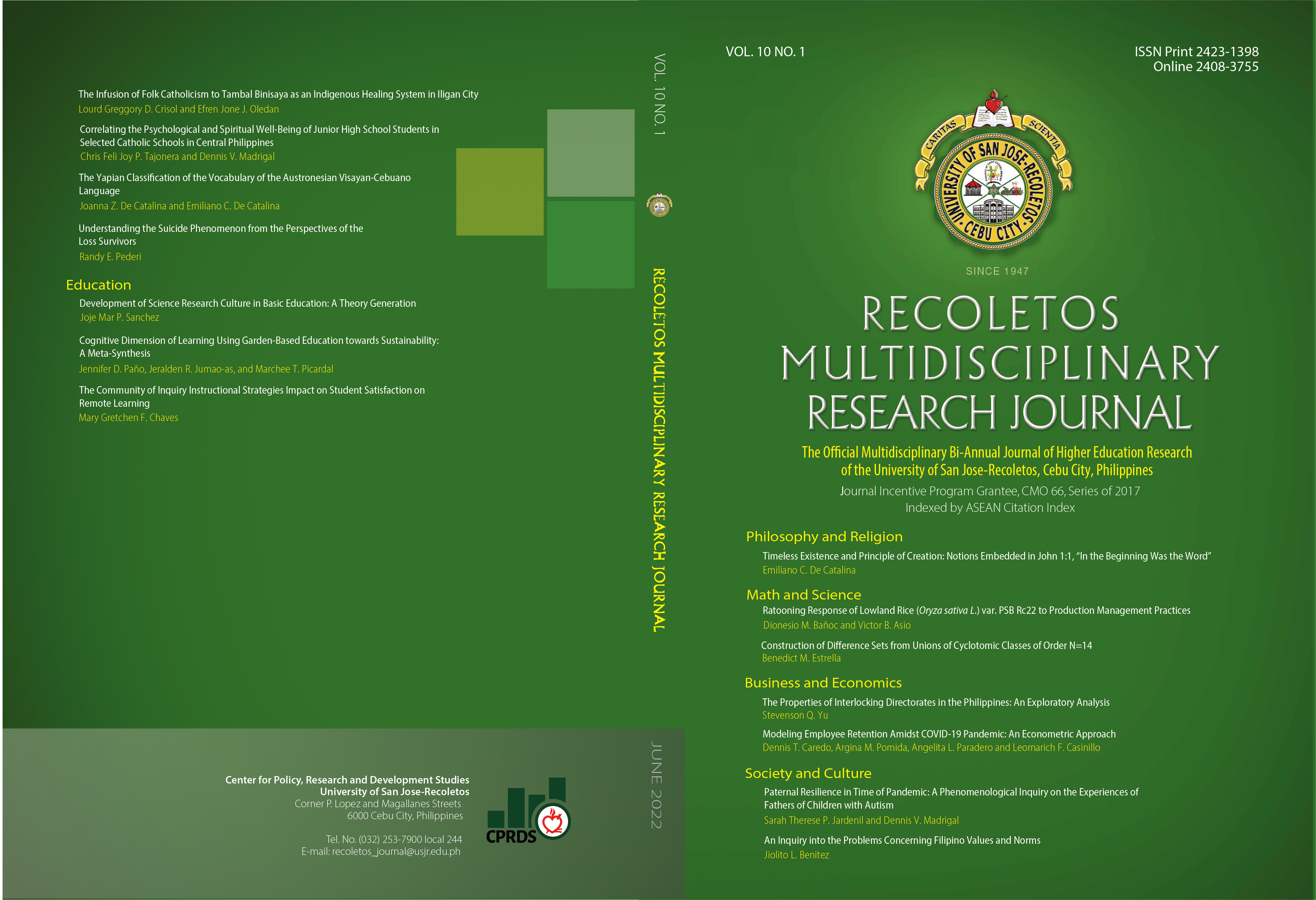
The celebration of the 500 years of Christianity in the Philippines was both a milestone and a challenge. Like a kilometer post that indicates where we are in our journey and how far we have to go yet, the celebration compels Filipinos to look back and embrace the future ahead.
The 10.1 Issue of the RMRJ will also bring us to a "looking back" of humanity's existence with the article " Timeless Existence and Principle of Creation: Notions Embedded in John 1:1, “In the Beginning Was the Word." The journal also looks into the collective and individual experiences during the pandemic that gave birth to the articles: "Modeling Employee Retention Amidst COVID-19 Pandemic: An Econometric Approach", " Paternal Resilience in Time of Pandemic: A Phenomenological Inquiry on the Experiences of Fathers of Children with Autism" and "Understanding the Suicide Phenomenon from the Perspectives of the Loss Survivors."
The present is the most solid anchor for any "looking back" activity. Hence, the issue includes concerns like the "Ratooning Response of Lowland Rice (Oryza sativa L.) Var. PSB Rc22 to Production Management Practices" "Construction of Difference Sets from Unions of Cyclotomic Classes of Order N=14", "The Properties of Interlocking Directorates in the Philippines: An Exploratory Analysis," and "An Inquiry into the Problems Concerning Filipino Values and Norms."
Daily activities and processes become the point of reflection and investigation like the articles "The Infusion of Folk Catholicism to Tambal Binisaya as an Indigenous Healing System in Iligan City," "Correlating the Psychological and Spiritual Well-Being of Junior High School Students in Selected Catholic Schools in Central Philippines," "The Yapian Classification of the Vocabulary of the Austronesian Visayan-Cebuano Language," "Development of Science Research Culture in Basic Education: A Theory Generation," "Cognitive Dimension of Learning Using Garden-Based Education towards Sustainability: A Meta-Synthesis," and "The Community of Inquiry Instructional Strategies Impact on Student Satisfaction on Remote Learning."
May this issue of the RMRJ be the readers' companion in their pursuit of answers for further inquiry and deeper reflection.
Adelante!
Professor NILO T. BUGTAI, Ph.D.
Editor-In-Chief
Full Professor of Manufacturing Engineering and Management (MEM)
Director, Institute of Biomedical Engineering and Health Technologies (IBEHT)
De La Salle University, Manila Philippines -
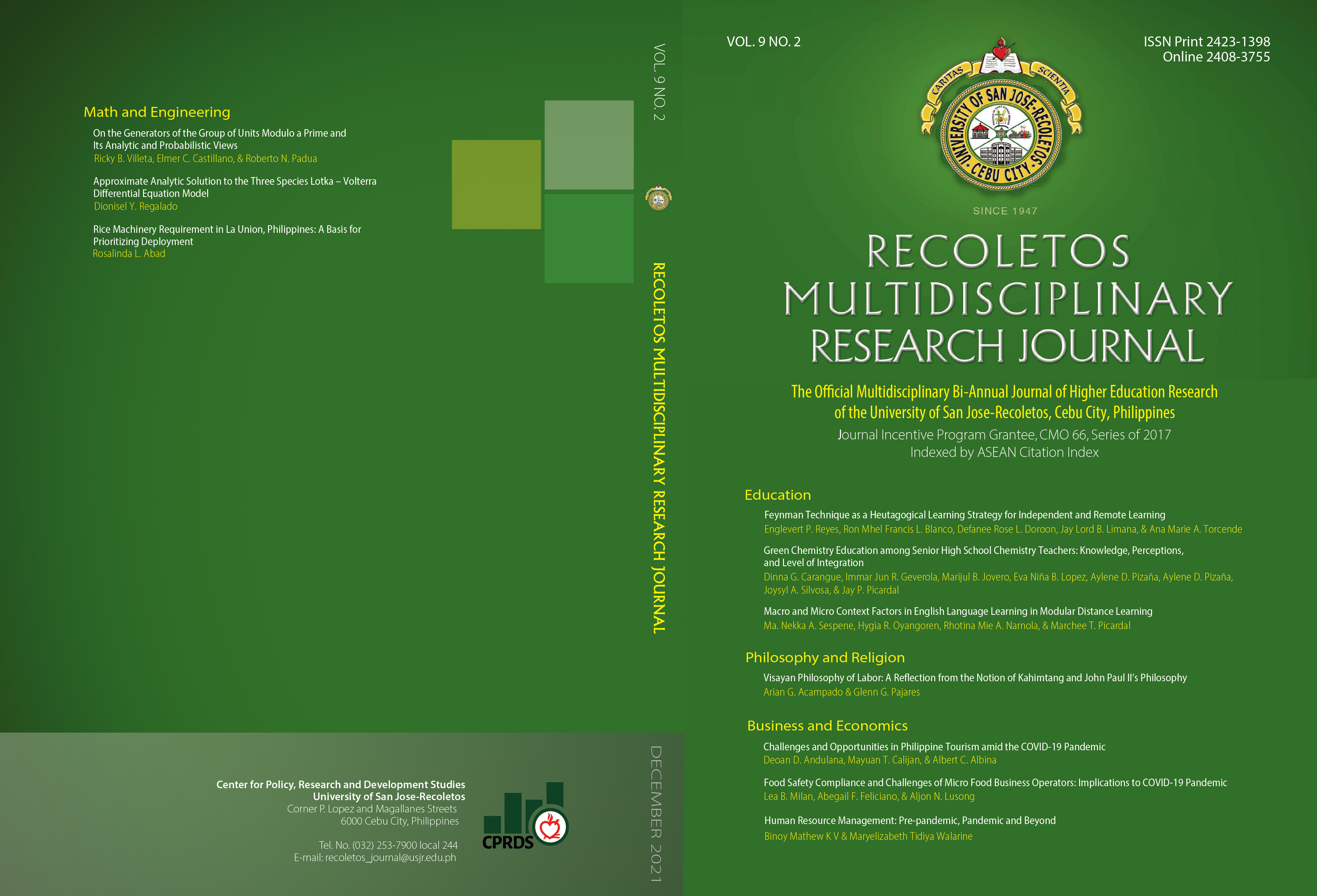
Vol. 9 No. 2 (2021)
Life can only be understood backwards; but it must be lived forwards. Life is not a problem to be solved, but a reality to be experienced.
Søren Kierkegaard
Two years into the pandemic and stories abound establishments closing, companies downsizing, individuals embracing virtual spaces, transactions migrating to online platforms, and more. To quote the philosopher Kierkegaard, “Life must be lived forwardâ€, and moving forward means getting up, rebuilding from the remnants of pandemic. For, after all, the subject of life is living, and to live is to be in the present moment and respond to the realities we experience.
In this issue of the RMRJ, we continue to rise up, rebuild, and further the discussion in the field of Education, with the papers: Feynman Technique as a Heutagogical Learning Strategy for Independent and Remote Learning, Green Chemistry Education among Senior High School Chemistry Teachers: Knowledge, Perceptions, and Level of Integration, and Macro and Micro Context Factors in English Language Learning in Modular Distance Learning.
In Math and Engineering, we shall learn more On the Generators of the Group of Units Modulo a Prime and Its Analytic and Probabilistic Views, Approximate Analytic Solution to the Three Species Lotka – Volterra Differential Equation Model, and Rice Machinery Requirement in La Union, Philippines: A Basis for Prioritizing Deployment.
While in Philosophy and Religion, we will have Visayan Philosophy of Labor: A Reflection from the Notion of Kahimtang and John Paul II’s Philosophy, and lastly, for Business and Economics, a glimpse into the Challenges and Opportunities in Philippine Tourism amid the COVID-19 Pandemic, Food Safety Compliance, and Challenges of Micro Food Business Operators: Implications to COVID-19 Pandemic, Human Resource Management: Pre-pandemic, Pandemic and Beyond.
We wish you an enjoyable and insightful reading ahead and an advance Merry Christmas and a Happy New Year!
Professor NILO T. BUGTAI, Ph.D.
Editor-In-Chief
Full Professor of Manufacturing Engineering and Management (MEM)
Director, Institute of Biomedical Engineering and Health Technologies (IBEHT)
De La Salle University, Manila Philippines -
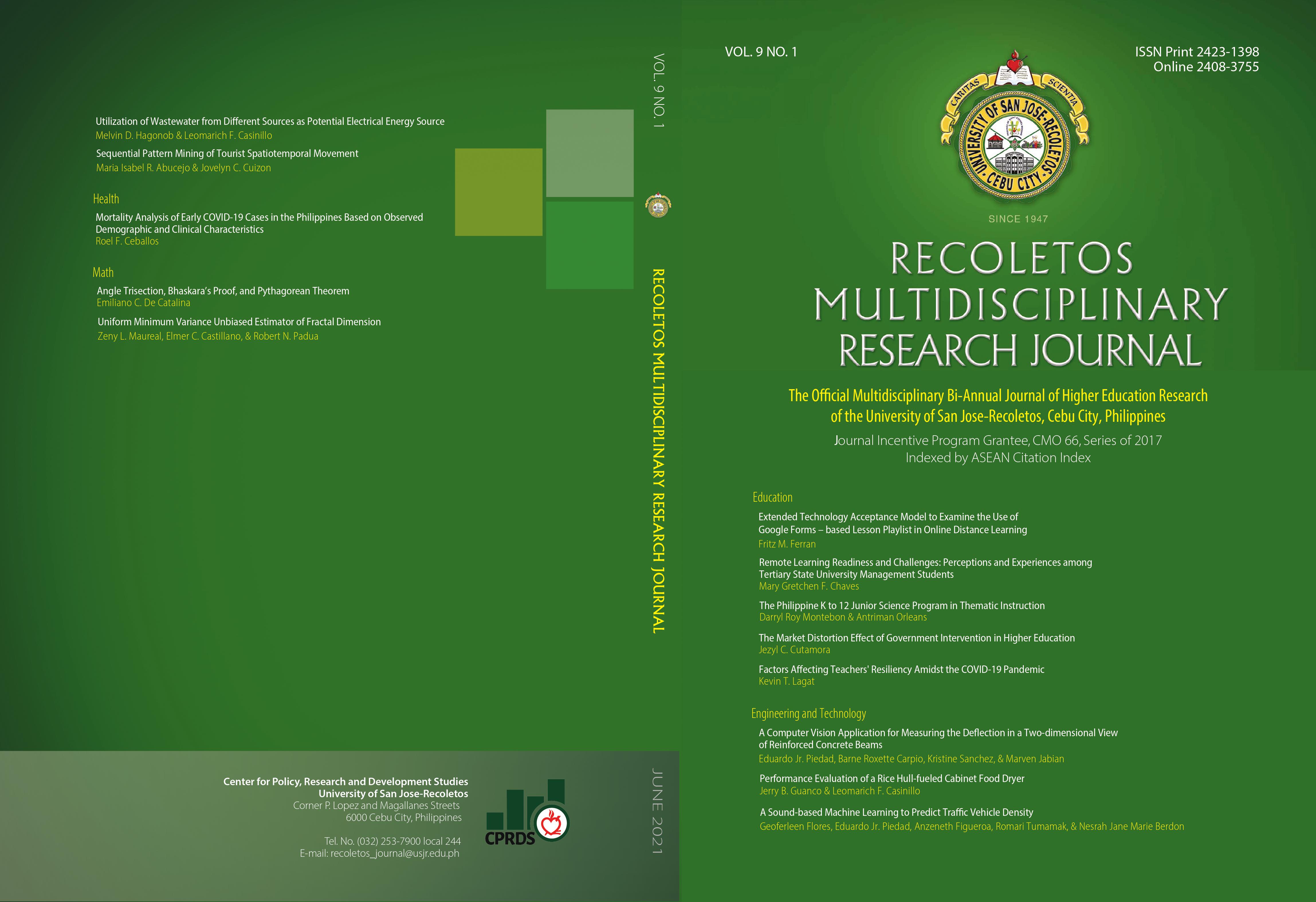
Vol. 9 No. 1 (2021)
The subject of life is living. Hence, to live means to move forward. COVID-19 challenged this and brought most businesses deemed as non-essentials, the schools, and activities like traveling to a standstill. It brought. Volatility, uncertainty, complexity, and ambiguity (VUCA) to humanity. To live, then, the human being has to rise from these challenges and get back to the race called life.
The 9.1 issue of the RMRJ centers on the theme RESILIENCY IN THE NEW NORMAL. Five articles, namely: "Extended Technology Acceptance Model to Examine the Use of Google Forms – based Lesson Playlist amidst COVID-19 Pandemic", "Remote learning readiness and challenges: Experiences among tertiary state university Management Students," "The Philippine K to 12 Program in Thematic Instruction", "The Market Distortion Effect of State Intervention in Higher Education," and the "Factors Affecting the Teachers' Resiliency Amidst the Covid-19 " explore how resiliency is exhibited in the field of education and how education can be more responsive to the present situation.
Research and development in the field of Engineering and Technology will be essayed in "A computer vision application for measuring deflection in two-dimensional view of reinforced concrete beams," "Performance Evaluation of Rice Hull-Fueled Cabinet Food Dryer," "A Sound-based Machine Learning to Predict Traffic Vehicle Density," "Sequential Pattern Mining of Tourist Spatiotemporal Movement Patterns," and "Utilization of Wastewater from Different Sources as a Potential Sources of Electrical Energy."
In the article," Mortality Analysis of Early COVID-19 Cases in the Philippines Based on Observed Demographic and Clinical Characteristics", the disease that restricted and affected the whole world will be brought to light again to understand it further.
The challenge of moving forward will also be responded to in the Math papers that tackle "Angle Trisection, Bhaskara's Proof, and Pythagorean Theorem" and the 'Uniform Minimum Variance Unbiased Estimator of Fractal Dimension."
May you be helped by this June 2021 (9.1) issue of the RMRJ in one way or the other and encourage resiliency in others, too.
Godspeed and Adelante!
Professor NILO T. BUGTAI, Ph.D.
Editor-In-Chief
Full Professor of Manufacturing Engineering and Management (MEM)
Director, Institute of Biomedical Engineering and Health Technologies (IBEHT)
De La Salle University, Manila Philippines -
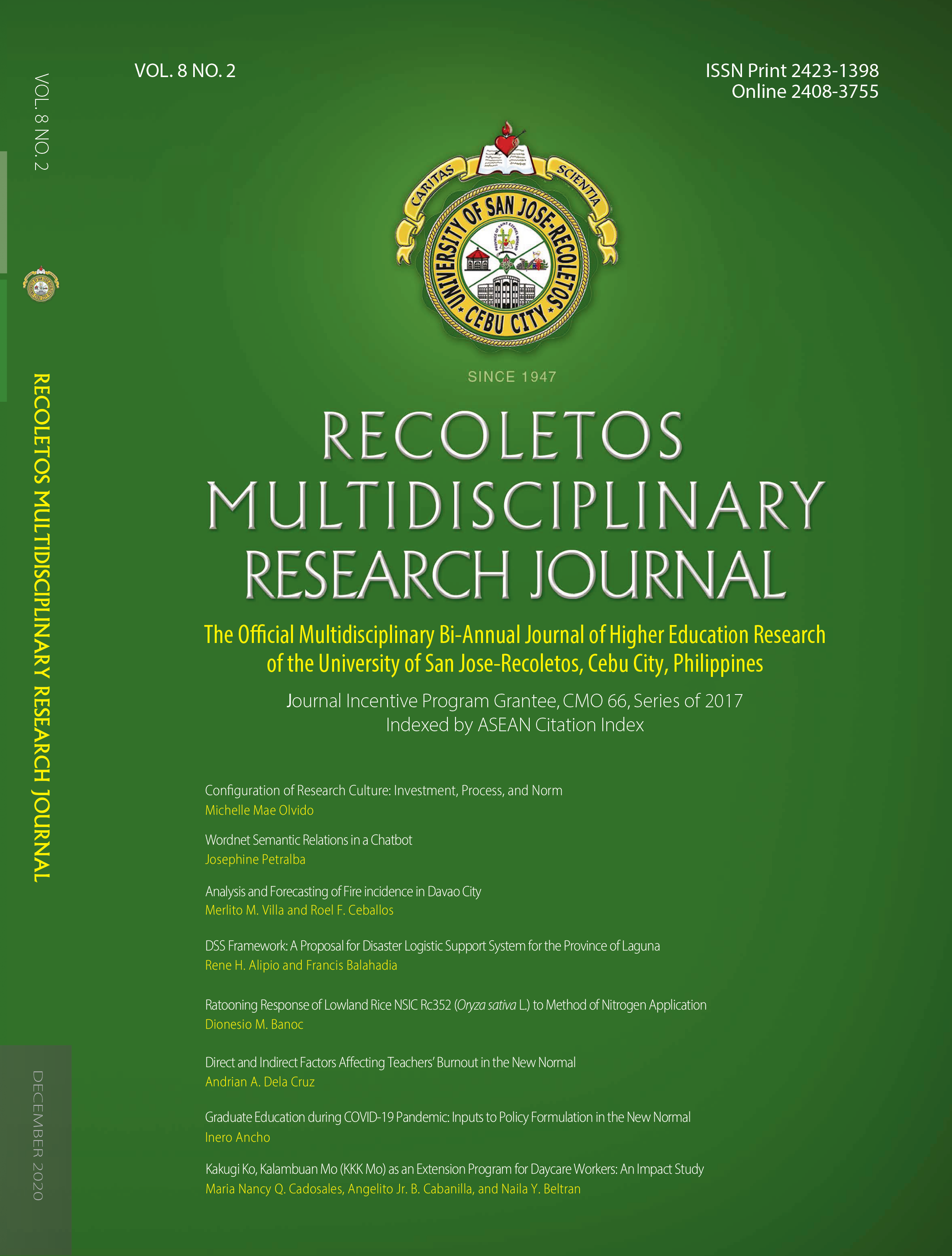
Vol. 8 No. 2 (2020)
Wishing you a Blissful New Year!
The year 2020 was challenging for everyone. Yet, it brought lessons, growth, and new ways of doing things.
In this issue of the RMRJ, we will look into the importance of research in the Configuration of Research Culture: Investment, Process, and Norm.
Innovations and looking at things with fresh perspectives will be essayed in the
Analysis and Forecasting of Fire Incidence in Davao City, Wordnet Semantic Relations in a Chatbot, Ratooning Response of Lowland Rice NSIC Rc352 (Oryza sativa L.) to Method of Nitrogen Application, DSS Framework: A proposal for a Disaster Logistic Support System for the Province of Laguna, and Kakugi Ko, Kalambuan Mo (KKK Mo) as an Extension Program for Daycare Workers: An Impact Study.The realities that we experienced during this pandemic will also be investigated in the Graduate Education during COVID-19 Pandemic: Inputs to Policy Formulation in the New Normal and the Direct and Indirect Effects to Teachers’ Burnout in the New Normal.
The year ahead might be uncertain, but the flicker of hope in each one of us must be kept alive. May RMRJ be an instrument of fanning that hope in individuals and academic communities it reached.
Professor NILO T. BUGTAI, Ph.D. (Loughborough University, England U.K.)
Director, Institute of Biomedical Engineering and Health Technologies (IBEHT)
Full Professor of Manufacturing Engineering and Management (MEM)
Technical Expert, DLSU - Innovation and Technology Office (DITO)
De La Salle University - John Gokongwei Jr. College of Engineering
2401 Taft Avenue, Malate, Manila 0922, Philippines
Phone: +(632) 8524-4611 Local 239 | 244
Email: [email protected] | [email protected] -
Vol. 7 No. 2 (2019)
Editorial Message
It is with great pride and joy to invite you to read the latest issue of the Recoletos Multidisciplinary Research Journal (RMRJ). Before moving forward, I would like to have this opportunity to thank our readers, our contributors and researchers, and our editorial board for their time and effort that had gone into the development of this issue.
As we look at the RMRJ, it represents innovation and the collective thinking of a group to satisfy the thirst and hunger for knowledge. It is a known fact that part of human nature is its curiosity and naturally intrigued.
The RMRJ seeks to be the leader in promoting multidisciplinary research. It believes that multidisciplinary research shall be the gold standard of the entire scientific paradigm. It encourages different researchers from different fields to form and engage in solving different, complex scientific problems, innovating to improve our lives, and understanding human nature. At our time right now, there has been an increase undertaking of multiple disciplines being discussed under a single subject, increasing the need for us to engage in multidisciplinary studies.
We want RMRJ as one of the forefront journals that would make a great difference and impact on the academic community. That is why it is one of our next goals in the future to be indexed under SCOPUS. We would do our best to make sure we achieve that goal and keep being an avenue of multidisciplinary research.